Protecting Our Herds: What Ranchers Need to Know About the New World Screwworm

Here at Just OK Ranch, keeping our animals healthy, happy, and safe is our absolute top priority. Part of good herd management means staying informed about potential biosecurity threats, even those that haven't been seen in our pastures for decades.
Recently, the Texas A&M AgriLife Extension Service issued an updated educational factsheet regarding a parasitic pest that requires renewed vigilance from livestock producers: the New World Screwworm (NWS). While this pest was eradicated in the United States back in the 1960s, recent detections in Texas and New Mexico mean it is time for ranchers to refresh their knowledge on what to look for and how to protect their livestock.
What is the New World Screwworm?
The New World screwworm (Cochliomyia hominivorax) is a highly destructive parasitic fly native to the Western Hemisphere. Unlike standard blow flies that lay eggs on deceased tissue, the female NWS fly deposits her eggs directly into the living tissue of fresh, open wounds on warm-blooded animals.
Once the eggs hatch, the larvae (maggots) enter the wound and aggressively feed on the host's living flesh. If left undiscovered and untreated, this feeding behavior causes extensive, severe tissue damage and can frequently be fatal to the animal.
Though eradicated in the U.S. decades ago through the release of sterile males (the sterile insect technique, or SIT) alongside active surveillance, the pest has reemerged.
Critical Signs of Infestation
Because the larval stage is responsible for causing severe injury and massive economic loss, checking your herd regularly during your normal biosecurity routines is essential. The name "screwworm" comes from the way the maggots use sharp mouth hooks to burrow in a screw-like fashion deep into the living flesh.
Producers should immediately look for the following warning signs in their cattle, horses, or domestic pets:
Foul-smelling wounds that contain visible, burrowing maggots.
Animals repeatedly biting or licking at a specific wound site.
Suspicious lesions or swelling in highly vulnerable areas like fresh navels on newborns, ears, or recent dehorning and branding sites.
Unusual behavioral shifts, such as marked restlessness, irritation, head-shaking, or extreme lethargy.
Note: Any live mammal or bird exhibiting a strong smell of decay, showing signs of flystrike, or displaying highly irritated behavior should be inspected immediately.
How to Identify the Pest
It is easy to mistake the New World screwworm for common, non-threatening flies, but a few distinct physical traits can help you spot a suspect case.
The Larvae (Maggots)
Size & Shape: Mature larvae can reach up to 17 mm (about 2/3 of an inch) in length.
Appearance: They feature tiny, dark spines that protrude from the body and wrap around in a distinct spiral pattern.
Official ID: True confirmation relies on the presence or absence of dual internal breathing tubes. Because identification requires a trained expert, any suspected larval specimens must be submitted directly to the Texas Animal Health Commission (TAHC).
The Adult Flies
Color: Adult NWS flies are a shiny, metallic blue color.
Markings: They feature three distinct dark stripes running down the top of the thorax (just behind the head) and possess large, bright orange eyes.
The Lookalike: NWS flies closely resemble the secondary screwworm fly (Cochliomyia macellaria), which is also metallic blue with three stripes. However, secondary screwworm stripes all begin at the exact same point behind the head, and crucially, they do not lay eggs on living tissue or pose a threat to animal health.
If you spot an adult fly of interest, take a clear photograph and email it to the Texas A&M AgriLife Extension Service at screwworm@ag.tamu.edu.
What to Do If You Suspect a Case
Because typical insecticide suppression is often less effective due to the screwworm's massive wildlife host range, rapid reporting is our best line of defense. If you have an animal showing suspicious symptoms, do not transport it, as this can accidentally spread the parasite to new regions.
Isolate the animal immediately and contact:
Your local veterinarian or wildlife biologist.
The Texas Animal Health Commission: (800) 550-8242.
The USDA Veterinary Services: (512) 383-2400.
Prevention and Treatment Options
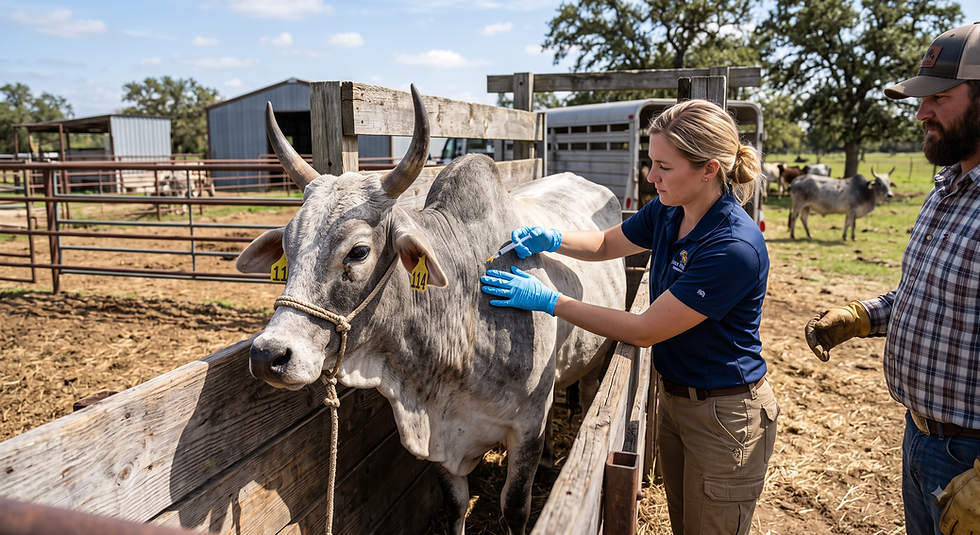
U.S. livestock producers have not had to routinely treat herds for this threat in over 40 years. However, modern veterinary medicine provides effective strategies should an emergency arise. Always consult your local veterinarian before administering care, but general strategies include:
Preventive Measures: Promptly treating any open cuts, scratches, or operational wounds on your animals, while maintaining strict sanitation across working facilities.
Fly Control: Responsible use of insecticides and fly population control (feed through fly prevention, fly repellent ear tags, fly control bags, and fly control spray) can decrease risk and help prevent infection.
Post-Infestation Treatments: Meticulous cleaning and physical removal of the larvae from the wound, followed by the application of approved topical larvicides (such as permethrin or coumaphos).
By staying alert, keeping our pastures clean, and examining our calves and cows closely during routine checks, we can keep our herds safe from reemerging biosecurity threats. Keep your eyes open out there!
For More Information Visit: https://agrilifeextension.tamu.edu/new-world-screwworm

Comments